

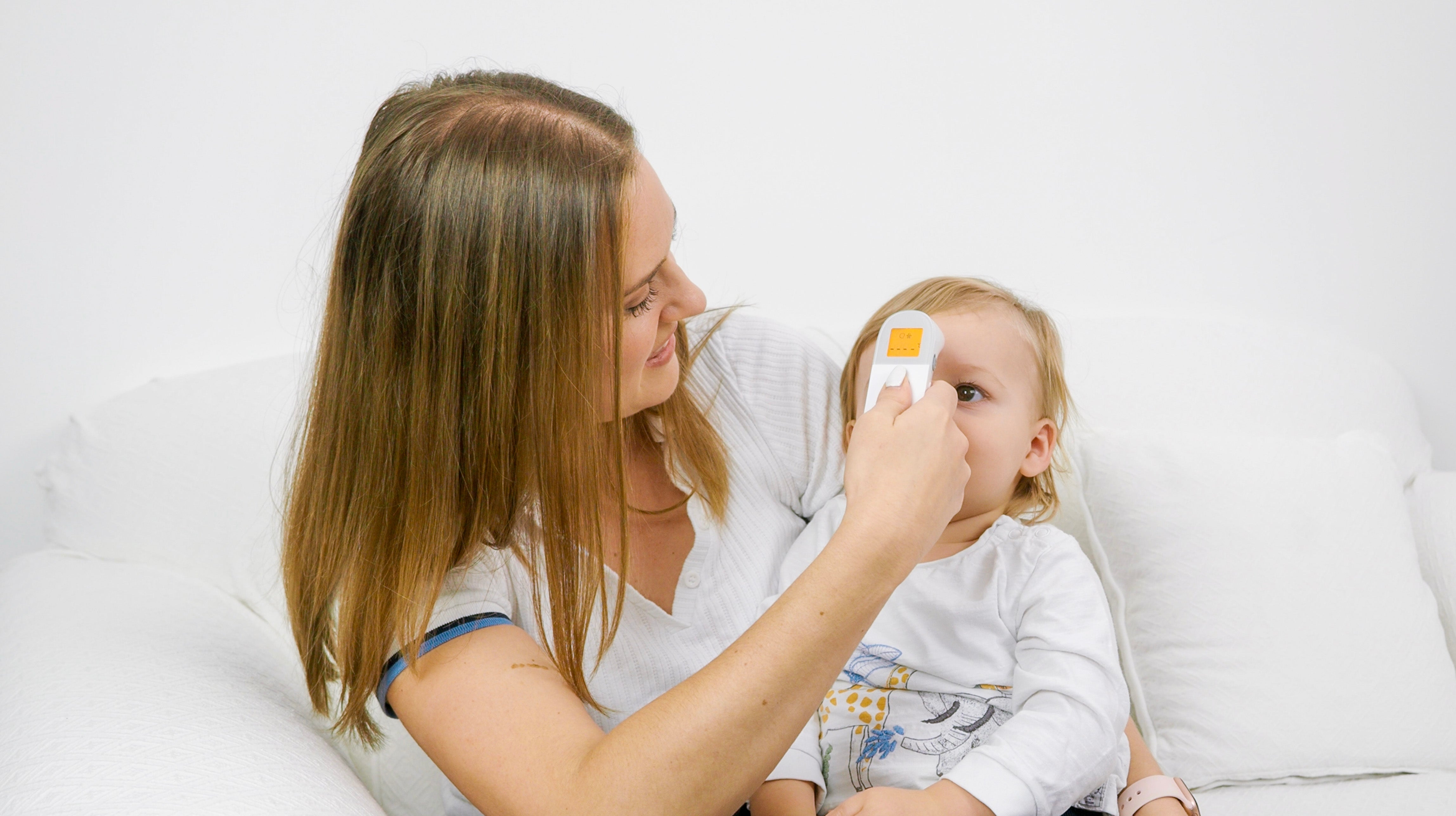
Quick answer: Hold the thermometer 2 to 3cm from the centre of a clean, dry forehead, keep it steady, and press scan. Make sure the forehead is free of sweat, hair and makeup, and let the thermometer sit at room temperature for a few minutes if it has been somewhere hot or cold. Use the same method each time so you can compare readings.
A non-contact forehead thermometer is one of the easiest ways to check a temperature, especially on a sleeping baby. But small habits make a big difference to how accurate the reading is. Here is how to get it right every time.
Why technique matters
Infrared thermometers read the heat coming off the skin. Anything that changes the skin surface, like sweat, hair, a recent bath, or coming in from the cold, can nudge the reading up or down. Good technique removes those variables so the number you see reflects your child's actual temperature.
Step by step: forehead mode
- Let it settle. If the thermometer has been in a cold car or a warm room, let it sit in the room where you will use it for 5 to 10 minutes first.
- Check the forehead. It should be clean and dry. Wipe away sweat and move any hair or a fringe out of the way.
- Aim for the centre. Point the sensor at the middle of the forehead, between the eyebrows and the hairline.
- Hold the right distance. Keep the sensor about 2 to 3cm from the skin, or follow the distance marked in your device guide.
- Stay steady and scan. Hold still and press the scan button. The reading appears in about a second.
- Read and note it. If you are tracking a fever, write down the time and the reading so you can see the trend.
Using ear mode
Many infrared thermometers, including the Elle TENS infrared thermometer, also offer an ear setting. Switch to ear mode, gently place the sensor in the ear canal, and press scan. Ear readings can be useful for older babies and children. For newborns, the non-contact forehead method is usually the simplest and least disturbing.
Common mistakes to avoid
- Measuring over sweat or hair. Both block the sensor and can lower the reading. Always use a clean, dry, exposed forehead.
- Holding it too far away. Too much distance gives an unreliable result. Stick to the recommended 2 to 3cm.
- Reading straight after a bath, feed or play. Wait 10 to 15 minutes so the skin returns to its true temperature.
- Big temperature changes. Coming inside from a cold day or sitting by a heater can affect skin temperature. Give your child a few minutes to adjust.
- Switching methods. Comparing a forehead reading today with an ear reading tomorrow is misleading. Pick one method and stay with it.
What to do if readings disagree
If two readings are very different, take a breath and measure again after a few minutes, making sure the forehead is dry and you are at the right distance. A calm, settled child gives the most reliable result. Remember that how your child looks and behaves matters as much as the number. A baby under 3 months with a reading of 38°C or above should be seen by a doctor promptly. For the full picture, read what is a normal temperature for a baby, and when is it a fever.
Keeping it clean
One of the benefits of non-contact mode is that the device never touches the skin, so there is very little to clean. Wipe the sensor gently with a soft, slightly damp cloth or an alcohol wipe when needed, and let it dry fully before use. Store it somewhere at a stable room temperature.
Frequently asked questions
How far should I hold a forehead thermometer?
About 2 to 3cm from the centre of the forehead, unless your device guide states otherwise. Too far away reduces accuracy.
Why is my forehead thermometer reading low?
The most common causes are sweat or hair on the forehead, holding it too far away, a cold room, or reading too soon after coming indoors. Dry the forehead, get the distance right, and try again.
Can I use a forehead thermometer on a sleeping baby?
Yes, that is one of its biggest advantages. The non-contact reading takes about a second and rarely wakes a sleeping baby.
Are forehead or ear thermometers more accurate?
Both are accurate when used correctly. Forehead is easiest for newborns and sleeping babies, while ear can suit older children. Consistency of method matters more than the type.
Should I take more than one reading?
If a reading seems off, wait a few minutes and measure again with good technique. If your child seems unwell, focus on their symptoms and seek advice rather than chasing the perfect number.
This article is general information only and is not a substitute for medical advice. If you are worried about your child, contact your GP, call Healthdirect on 1800 022 222, or in an emergency call 000.
A fast, non-contact thermometer for the whole family
The Elle TENS infrared thermometer reads in about one second, with forehead and ear modes and a fever alert.


